
Content


VAIC: Vision-Guided Humanoid Agile Object Interaction Control via Decoupled Commands

*Equal Contribution    Corresponding author
1 Tsinghua University    2 HKUST(Guangzhou)    3 Xiaomi Robotics Lab
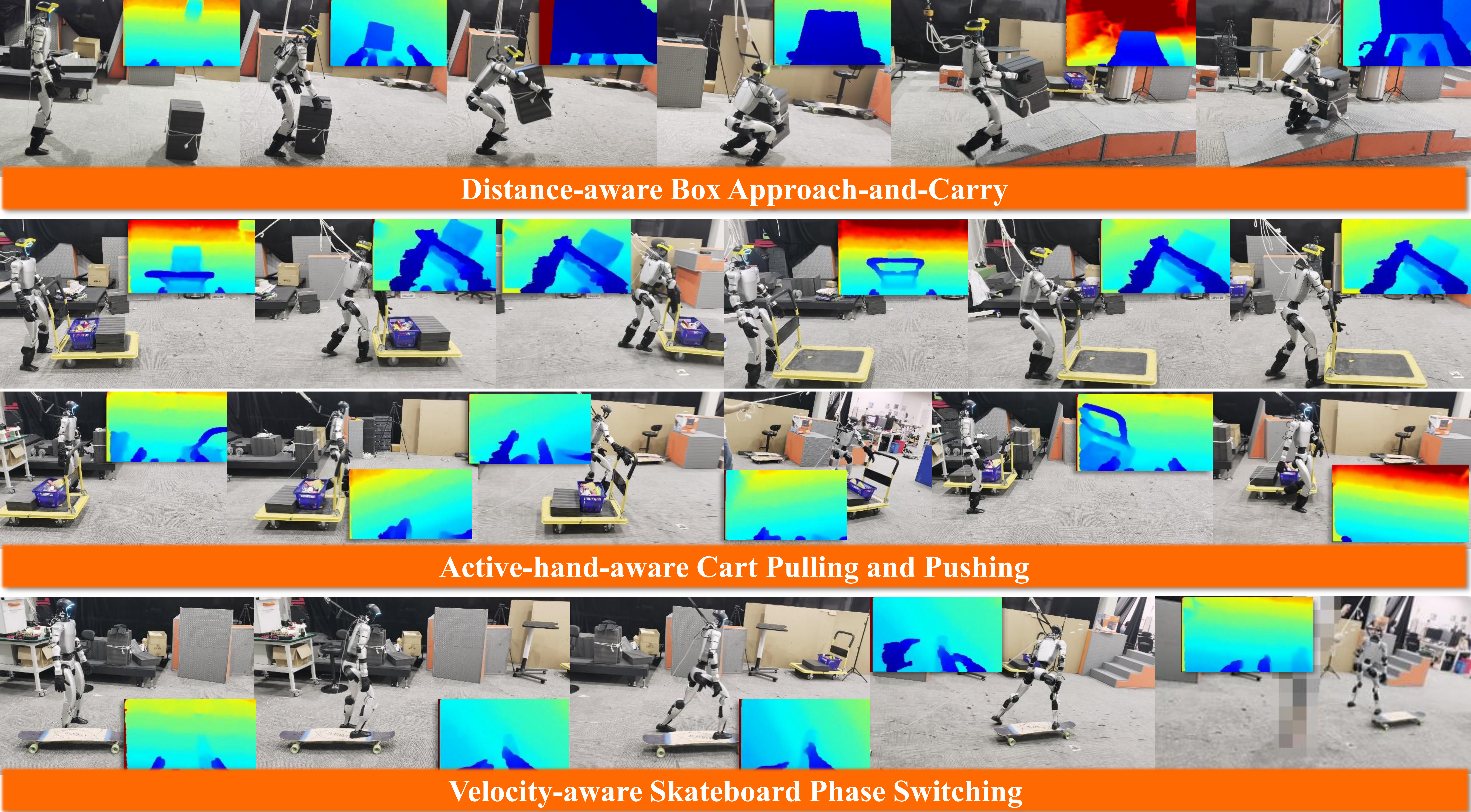
VAIC teaser

Abstract

Humanoid robots hold immense potential for real-world assistance, yet agile interaction with objects in unstructured environments demands tightly coupled whole body coordination. Despite recent advancements, current controllers face a critical deployment gap. They rely heavily on dense reference trajectories and perfect state observability, which inherently limits physical generalization. We present Vision Guided Agile Interaction Control (VAIC), a unified framework that bridges this gap by operating exclusively on onboard depth, historical proprioception, and a decoupled user command interface. VAIC employs a two-stage distillation paradigm. First, a privileged teacher policy masters diverse interaction skills using precise object kinematics and exact environmental states. Second, a deployable student policy distills these capabilities by replacing full body tracking with velocity targets across multiple axes and an interaction indicator for each frame. The student utilizes a recurrent object adaptation module to implicitly infer unobservable object dynamics from raw depth streams and proprioception. Evaluations and real-world deployments on the humanoid robot demonstrate that a single VAIC policy successfully executes highly diverse dynamic tasks. These tasks include box carrying, cart interaction, and skateboarding, consistently outperforming baselines and advancing autonomous humanoid deployment.

Box Interaction

Box Pick and Place

Cross Slope

Find a Box

Cart Interaction

Cart Pushing

Find a Cart

Cart Pulling (Left Hand)

Cart Pulling (Right Hand)

Skateboard Interaction

Skateboarding

Generalization

BibTeX

@article{li2026vaic,
  title = {VAIC: Vision-Guided Humanoid Agile Object Interaction Control via Decoupled Commands},
  author = {Li, Dongting and Wu, Qianyang and Chen, Xingyu and Li, Liang and Lin, Yuhang and Wu, Sikai and Zhang, Guoyao and Zhou, Mingliang and Xiang, Diyun and Zhang, Qiang and Xu, Renjing and Ma, Jianzhu},
  journal = {arXiv preprint arXiv:2606.09286},
  year = {2026}
}